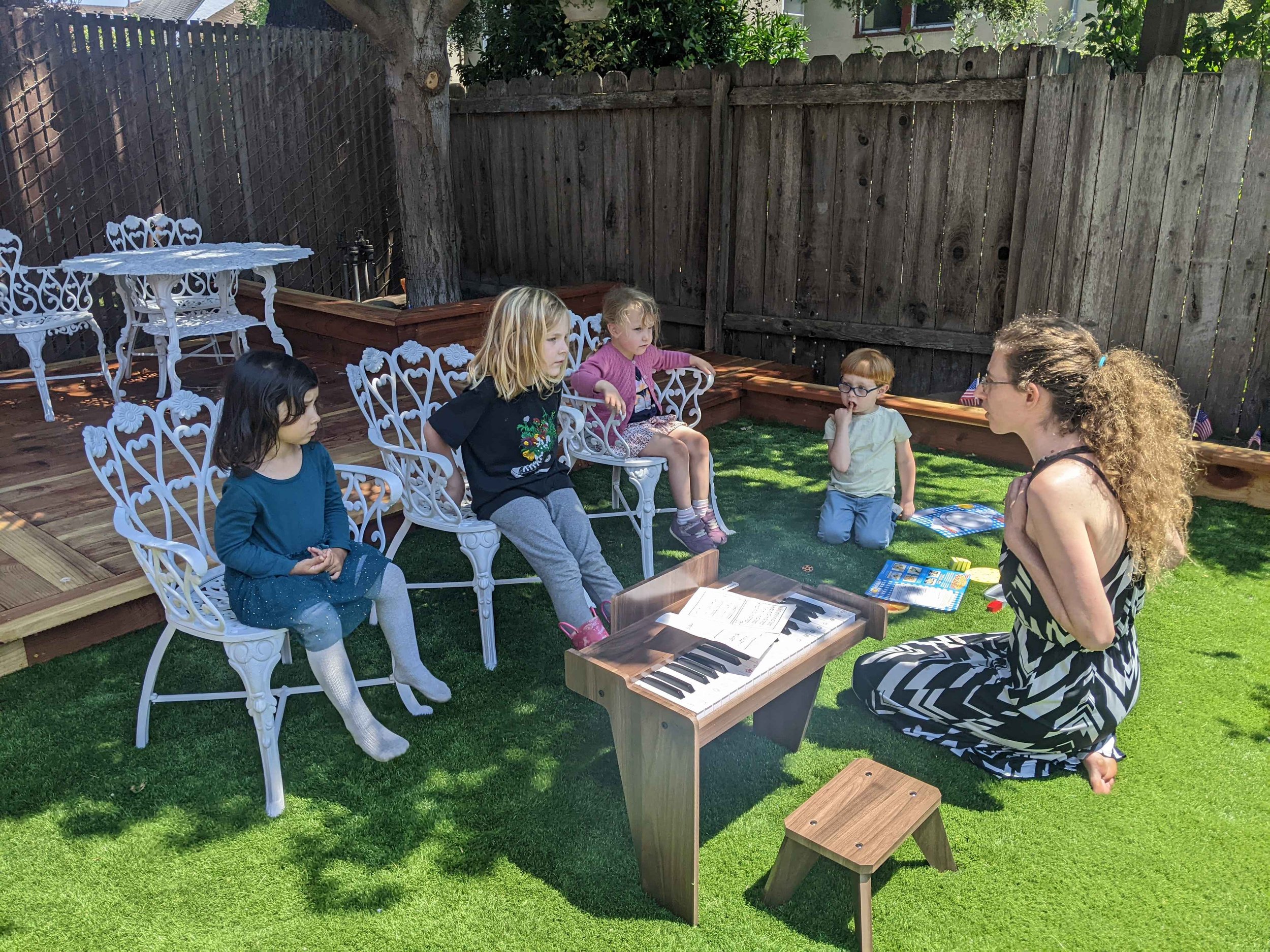
A different kind of school
We don’t want to waste kids’ time.
Our core principles are simple: we believe that instruction should be targeted to best serve each student, and that students should be bought in on learning to the greatest extent possible.
Targeted instruction means that we test each student’s abilities on entry, and move each student through core instruction as fast as they can master each concept (and no faster). Parents and students do not have to lobby for consideration for a gifted program or for ‘enrichment’ when a student is bored: if they’re ready, they will be immediately placed into more advanced material. If a student has mastered something, it’s time for them to move on. If they don’t have the context needed to understand a concept, it’s time to move back to where the student is struggling and build up stronger foundational knowledge.
For some students, this looks like skipping 50% of the exercises in a book and moving on to new material without wasting time with unnecessary review. For others, it looks like completing the same grade of material across two different curricula, because the student needs that much practice to develop true mastery over the skills. In both cases, a majority of students progress faster than than would be expected of them in a traditional school.
Because we offer targeted instruction, kids are able to learn more. That looks different for every child. Some students read and analyze adult novels in third or fourth grade. Some take high school math classes. In our literature-focused history classes, students read a novel every week.
But why would students do all that work, especially if in some cases it means doing twice as much? How do you build a culture in which students are motivated to do so much more?
Student buy-in is at the core of what we do. Students set quarterly goals with their teachers. Students who finish their work early can leave the class to play outside. Students in kindergarten choose how to spend their time in a Montessori-style child-led setting, where classes are optional. In upper grades, we offer custom work built around a student’s unique interests and fascinations. If a child is passionate about dinosaurs, we can make all their language arts and much of their science work be about dinosaurs. If they love Pokemon, we have a Pokemon-based writing curriculum that has taken students from kindergarten-level to fourth-grade level writers in a single year.
We ask a lot of our students. We try to give them a lot too: we match their effort with a teaching staff that has low ratios and can design work that each child is motivated to do, work tailored to their specific strengths and weaknesses. Kids are motivated to achieve when they know that we believe in them, support them, work hard to ensure the work in front of them is worth their time, and care about their progress.
Do kids just grind through work all day?
No. School takes hard work, but it’s not good for kids to work all day - and kids do also learn essential life lessons through board games and unstructured outdoor play. A focused student can often complete their required work in a fraction of the school day, leaving them free to play, read, draw, or earn bonus rewards by completing even more schoolwork in their most challenging subject. Early elementary students do core work for about one or two hours a day (almost never in one sitting), and spend most of the rest of the day playing or reading for pleasure. Our soundproofed playroom and outdoor space ensure that kids can take breaks as needed without disturbing those who are still working. Late elementary students learn to do sustained work for longer periods - but still spend a lot of the day outdoors, playing board games, or reading in the library.
How do you make all this work? Small class sizes, building rapport with students, and a lot of teamwork with parents. With between 4 and 10 kids, our educators have time to figure out where each kid is at, design lessons uniquely for them, and work with them one-on-one, which is how many kids learn best. While the initial process of finding work a child is motivated to do may be time-consuming, students who have hit their stride and found materials that work for them often need less individualized lesson planning for some time. We also continually communicate with parents about what each kid is studying and what challenges they’re facing, and many parents drop in to teach guest lessons each week.
But it’s affordable? We want every Oakland family to be able to attend LEARN. Our base tuition is $31,000 a year. We offer financial aid and significant sibling discounts, and we are always working to bring LEARN within reach for more students. Thanks to donations, this year we are able to offer full scholarships to four Oakland students and half scholarships to four more students. With a full scholarship, LEARN is free. With a half scholarship, LEARN tuition is $15500 for the year.


All images are shared only with permission of both students and parents.


A day in the life
Since student activities depend a lot on what the kids are interested in, we try to keep rough notes on what the kids actually do. Here are some notes from a recent day:
All kids started the day with a math worksheet. K (age 4) practiced writing the number five, A (age 4) practiced adding and taking away one from a number, and V (age 6) practiced reading and writing large numbers. C (age 7) was given a multiplication worksheet, but she decided to read a book instead.
V requested a reading lesson after finishing his worksheet, and the younger kids ended up listening in to the story (Usborne’s Stories of Monsters). K requested help writing a sentence on the whiteboard. All of the kids had a short geography lesson about Canada.
During lunch, the teacher read aloud the beginning of What Is The Constitution?, a chapter book about the constitutional convention. K, A, and V finished lunch and left to go play, but C begged for more and listened for another half an hour, until it was time for recess.
The kids had an hour-long recess at a nearby park, and returned to the school a little early when half the class reported being hungry again. We finished reading the book while the kids had an afternoon snack, then answered followup questions about the right to freedom of the press, the right to assembly, and the idea of cruel and unusual punishment. C then tried, with difficulty, to read the constitution itself, while V asked for help figuring out how many points the children had to earn to meet all of their goals (a task that involved two-digit addition and subtraction).
In the afternoon, the kids had art class, making paintings and collages. C opted to play outside instead of painting, but later enjoyed making a collage.
K went home after art class. A spent the points she’d earned on watching several episodes of Numberblocks, while C and V worked on their Pathfinder character sheets, in an effort to get ready for a school tabletop rpg campaign. C ended up doing math after all, using addition, subtraction, and multiplication to keep track of her character’s carrying capacity, money, and inventory, while V took notes on his character abilities.
Oakland LEARN admits students of any race, color, national and ethnic origin to all the rights, privileges, programs, and activities generally accorded or made available to students at the school. It does not discriminate on the basis of race, color, national and ethnic origin in administration of its educational policies, admissions policies, scholarship and loan programs, and athletic and other school-administered programs.